Logistics · Transport & fleet

Logistics and transport software from booking to freight bill

A transport business is a set of promises about where things will be. Linksoft builds logistics software that tracks each consignment, each trip and each rupee of cost against those promises — so profitability per trip stops being a guess made at year end.

Where transport businesses lose money quietly

Very few transport operators can say what a specific trip earned. The freight is known, but fuel is bought against a slip, maintenance is remembered rather than recorded, tyre and driver costs are averaged, and the demurrage argument is settled from memory. The result is a business that knows it is busy and hopes it is profitable.

The fix is unglamorous: attach every cost to a trip and every trip to a vehicle, at the time it happens. Once that is true, profitability per vehicle, per route and per client stops being an annual mystery and becomes a weekly report.

Consignment tracking clients can rely on

A consignment is booked, loaded, dispatched, delivered and proved — with a document at each step and a client asking about it in between. The system holds that chain as one record: booking reference, vehicle, driver, route, expected and actual dates, and proof of delivery captured on a phone at the point of handover rather than photographed and forwarded later.

Because it is one record, the answer to 'where is my consignment' is a lookup instead of two phone calls, and the client can be given their own view rather than being told to ring the office.

  • 01 Booking to proof-of-delivery as one tracked record
  • 02 Proof of delivery captured on a phone in the field
  • 03 Vehicle, driver and route attached to every trip
  • 04 Client-visible status without a phone call to the office
  • 05 Documents — bilty, challan, POD — held against the consignment

Fleet, drivers and the cost of running them

Vehicles carry their own record: fuel issued, maintenance performed and due, tyre history, documents and their expiry dates, and the trips they ran. Drivers carry theirs: licence and its expiry, trips, advances taken, and settlements. Both feed trip costing, and both generate the reminders that stop an expired document becoming a roadside problem.

Freight billing that reconciles

Freight is billed per the client's agreed rate structure — per trip, per tonne, per kilometre, per container — with detention, demurrage and extra handling as documented lines rather than as a negotiation. Bills post into double-entry accounts, client balances age visibly, and FBR-compliant electronic invoicing issues from the same flow where the operator is registered for sales tax.

What the system includes

Modules are configured to your operation during scoping — you take what your business runs on and leave what it does not.

01

Consignment booking

Client, route, rate, expected dates and documents captured at booking.

02

Trip management

Vehicle, driver, route and status from dispatch through to delivery.

03

Proof of delivery

Delivery confirmation and documents captured on a phone at the point of handover.

04

Fleet records

Fuel, maintenance, tyres, documents and expiry reminders per vehicle.

05

Driver management

Licences and expiries, trip history, advances and settlements.

06

Trip costing

Every cost attached to its trip, giving profitability per trip, vehicle, route and client.

07

Freight billing

Rate structures, detention and demurrage billed as documented lines.

08

Accounting & FBR invoicing

Double-entry books posted from operations, with compliant e-invoicing from the same flow.

Where the proven parts come from — stated plainly

Logistics is on our owner-verified list of industries served, and the machinery is machinery we run: our textile system tracks goods received at the gate and dispatched to buyers with documentation attached, costs consumed against a specific order, and every movement posting into double-entry party ledgers automatically.

Trip costing is order costing with a vehicle in place of a production line. We would rather show you that working system and let you judge the transfer than describe a fleet client we do not have.

See the client register →

Screens from the system we are building

A goods-transport system is in active development, modelled on how Pakistani transport actually works: the bilty book and the loading challan, the margin argued at the truck adda, branch-wise cash, wasooli against parties, the POD register that decides when a truck owner gets paid, and sales tax invoices filed with FBR. These are real screens from it, in the order the work happens.

Al-Rehmat Goods Transport, and every party, figure and consignment shown, is sample data we created for development. It is not a client and does not represent a live deployment.
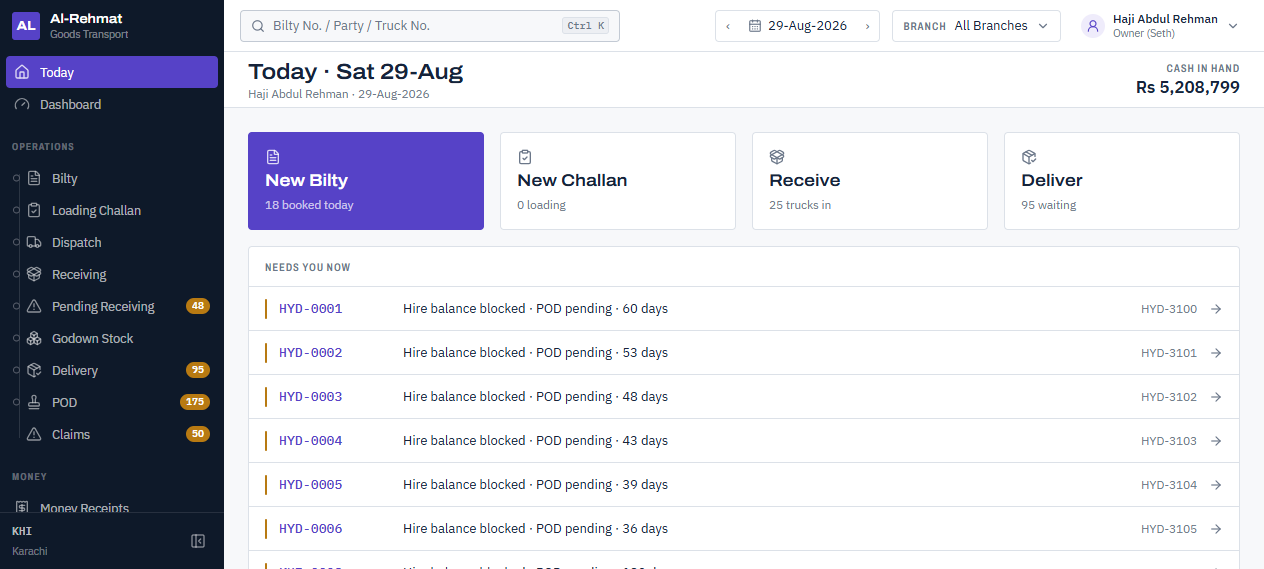
Today screen for a transport office showing cash in hand, four action tiles for new bilty, new challan, receiving and delivery, and a needs-you-now list of trips with hire balance blocked pending POD.
What the office opens on. Four things a clerk actually does, the cash figure, and underneath it every trip where the truck owner's balance is blocked because the POD has not come back, aged in days.
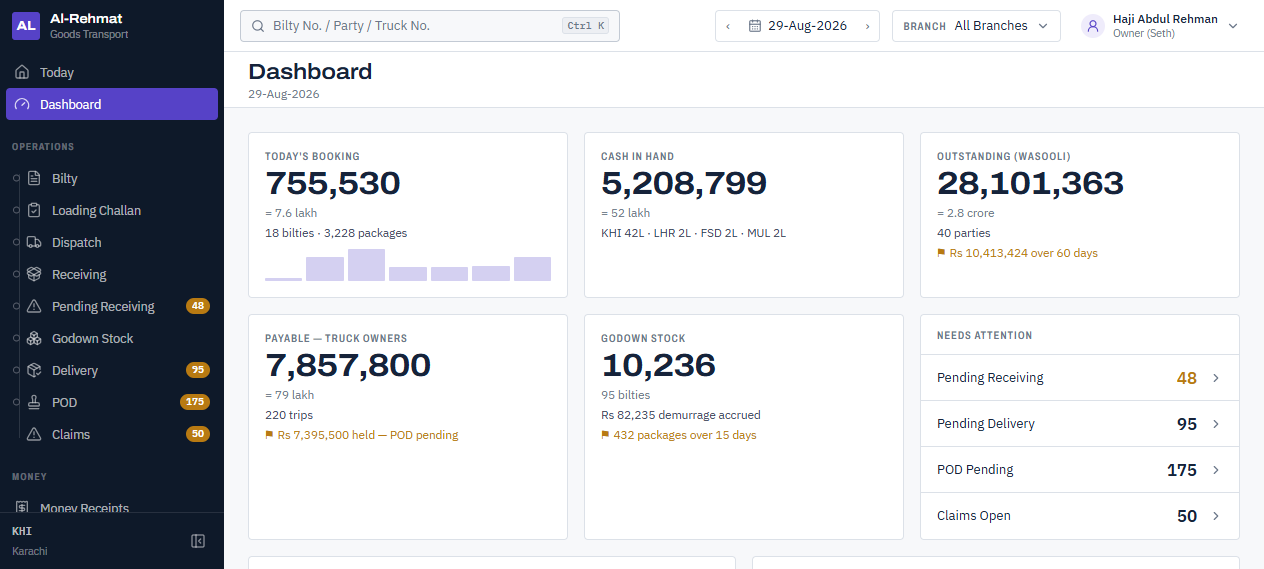
Transport dashboard showing today's booking, cash in hand, outstanding wasooli by party, payable to truck owners, godown stock and a needs-attention list.
The owner's morning view: booked today, cash in hand by branch, outstanding wasooli with the amount ageing past sixty days, and what is held against truck owners pending POD.
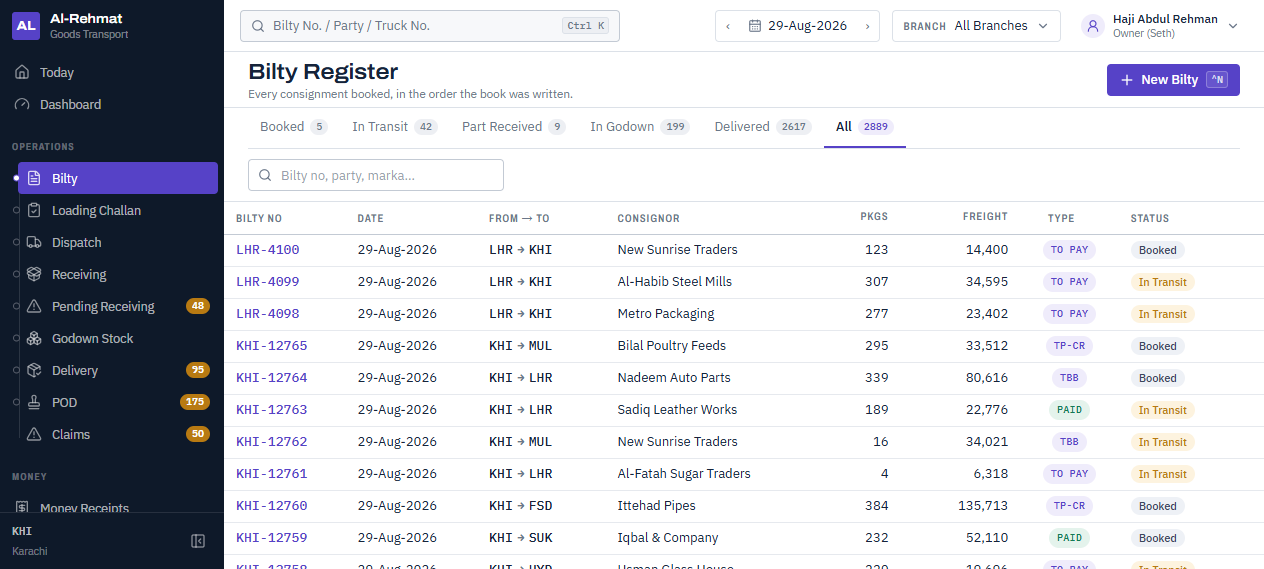
Bilty register listing every consignment booked, with bilty number, date, route, consignor, packages, freight, freight terms and status, tabbed by booked, in transit, part received, in godown and delivered.
The bilty register, in the order the book was written. The tabs across the top are the only statuses a consignment can be in, and the count beside each one is the register's own answer to "where is everything right now".
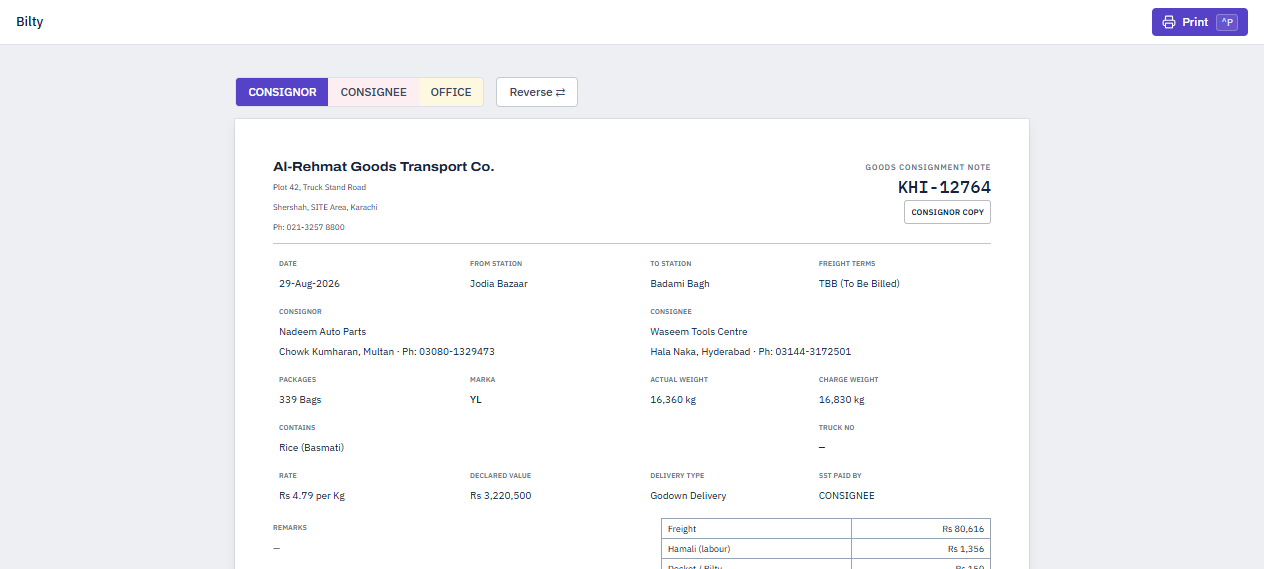
Printable goods consignment note showing consignor, consignee, packages, marka, weights, rate, declared value and a freight table, with tabs for the consignor, consignee and office copies.
The same three-copy bilty a booking clerk fills by hand today: consignor's white copy, consignee's pink, office's yellow. One entry produces all three, so they cannot disagree with each other, and the Carriers Act 1865 wording still prints on the reverse.
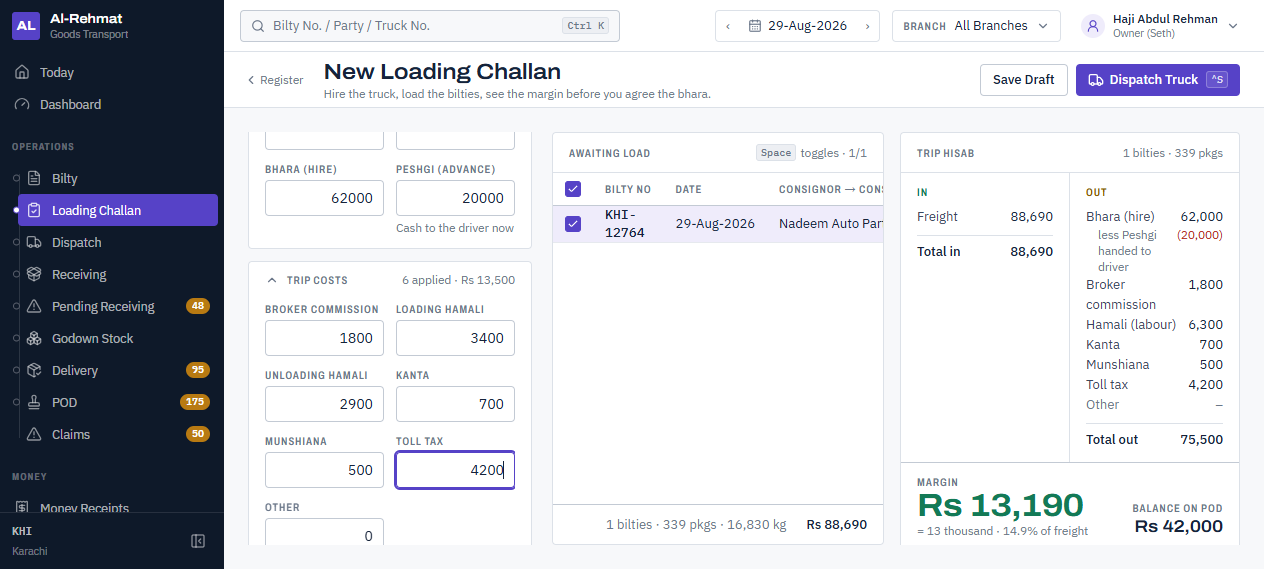
New loading challan screen with a trip hisab panel on the right showing freight in, bhara, peshgi, broker commission, hamali, kanta, munshiana and toll out, a total, and the resulting margin in rupees.
The screen the whole system is built around. As bilties are ticked onto the truck and the bhara is typed, the hisab panel on the right recomputes freight in against bhara, peshgi, broker commission, hamali, kanta, munshiana and toll, and prints the margin in the largest type on the page. You know whether a hire is worth taking before the truck leaves, not after.
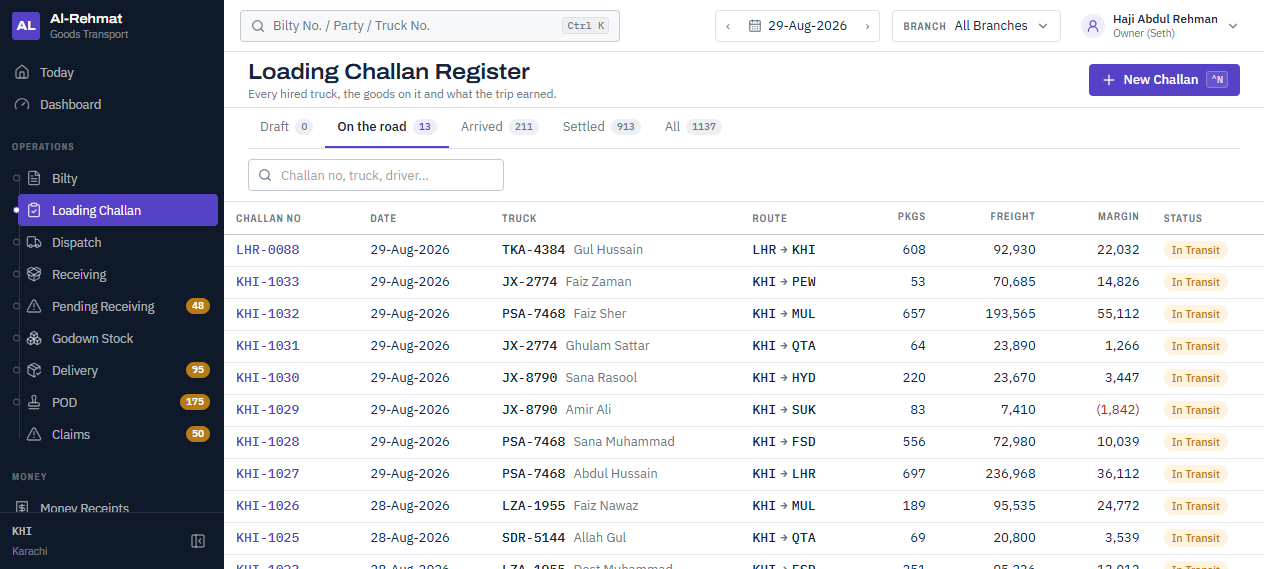
Loading challan register listing every hired truck with challan number, date, truck and driver, route, packages, freight, margin and status, tabbed by draft, on the road, arrived, settled and all.
Every hired truck with what the trip earned, in a column. A negative margin shows in brackets rather than being buried, because the trips that lost money are the ones worth finding.
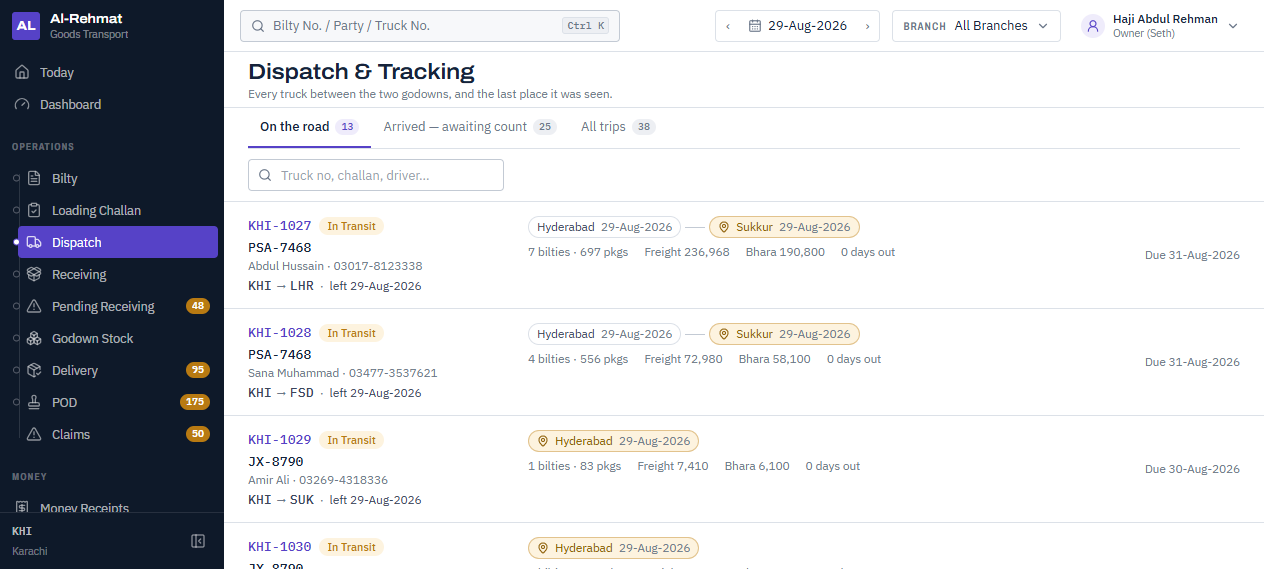
Dispatch and tracking screen listing trucks on the road with challan number, truck, driver and mobile, route, bilties, packages, freight, bhara, days out, last known location and due date.
Every truck between two godowns and the last place it was seen, with days out and the due date against each. This is the screen that answers the phone call asking where the goods are.
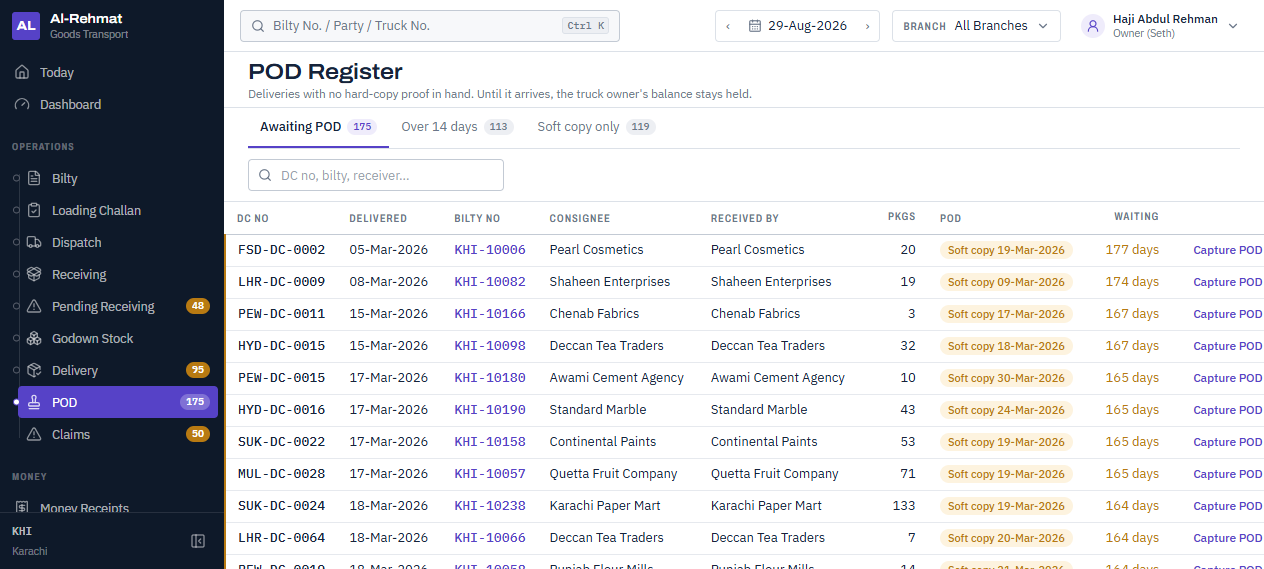
POD register listing deliveries awaiting hard-copy proof, with delivery challan number, bilty number, consignee, packages, soft-copy date and days waiting.
The POD register, split into awaiting, over fourteen days, and soft copy only. Until the hard copy arrives the truck owner's balance stays held, which is the rule the screen exists to enforce.
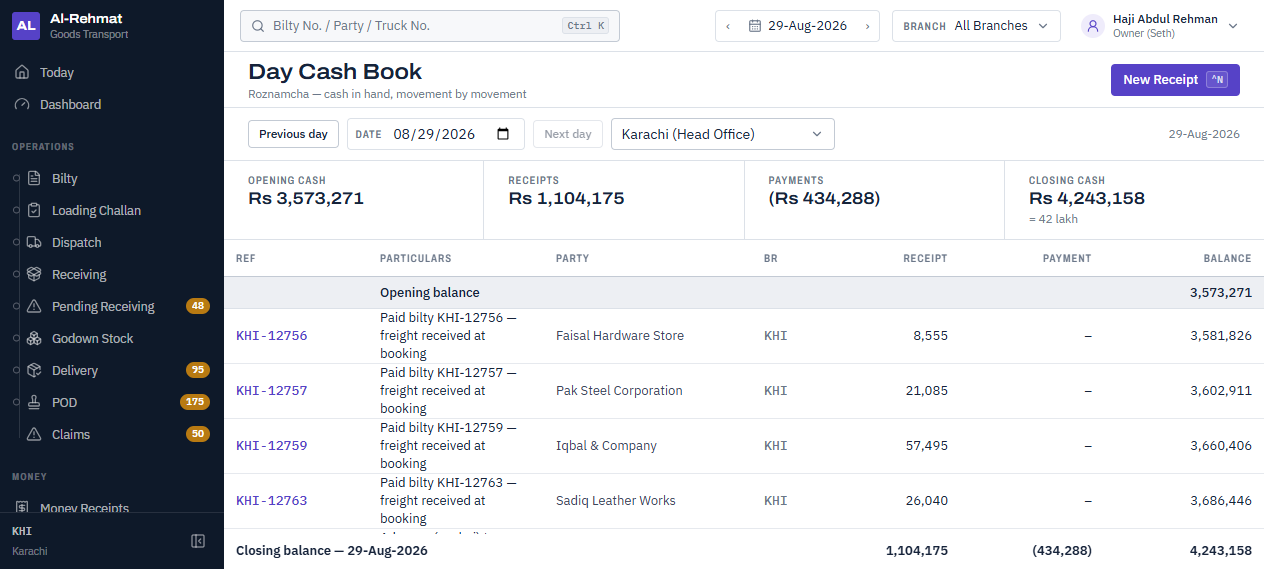
Day cash book showing opening cash, receipts, payments and closing cash for one branch on one date, with a running balance against every movement.
The roznamcha, kept by the system rather than by hand. Opening cash, every movement with the bilty or voucher it came from, and a closing balance that has to agree with the drawer at the end of the day.
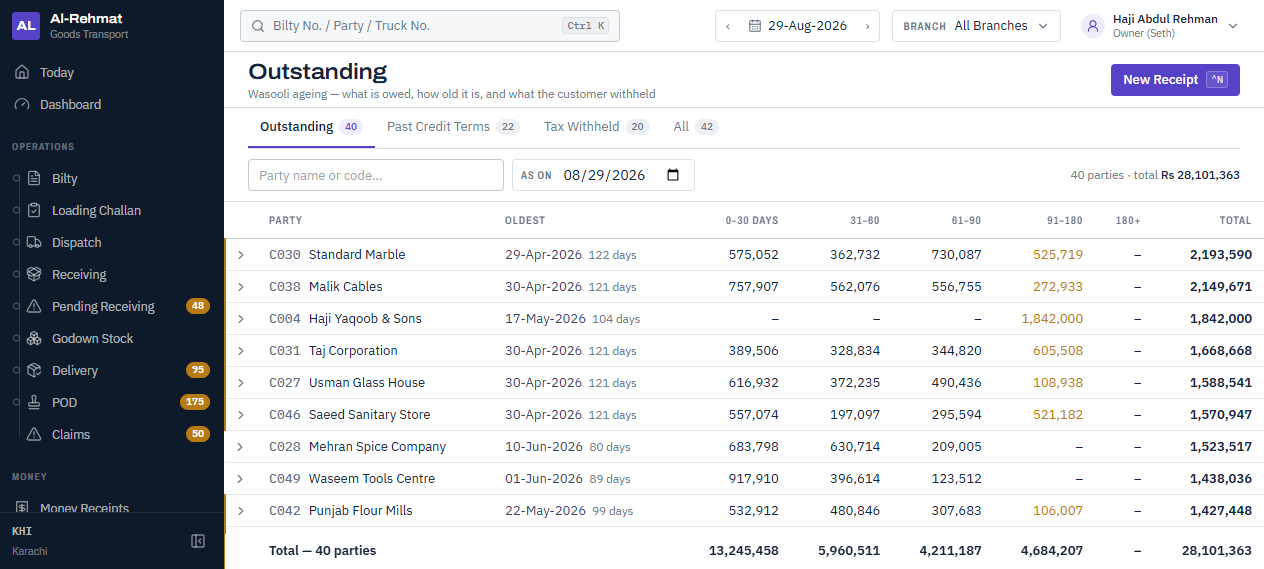
Outstanding receivables screen showing wasooli ageing by party in 0-30, 31-60, 61-90, 91-180 and 180-plus day buckets with the oldest unpaid date and a total per party.
Wasooli ageing, party by party, in buckets. The oldest column names the date the money first went unpaid, so a conversation about a 122-day-old balance starts from a fact rather than a feeling.
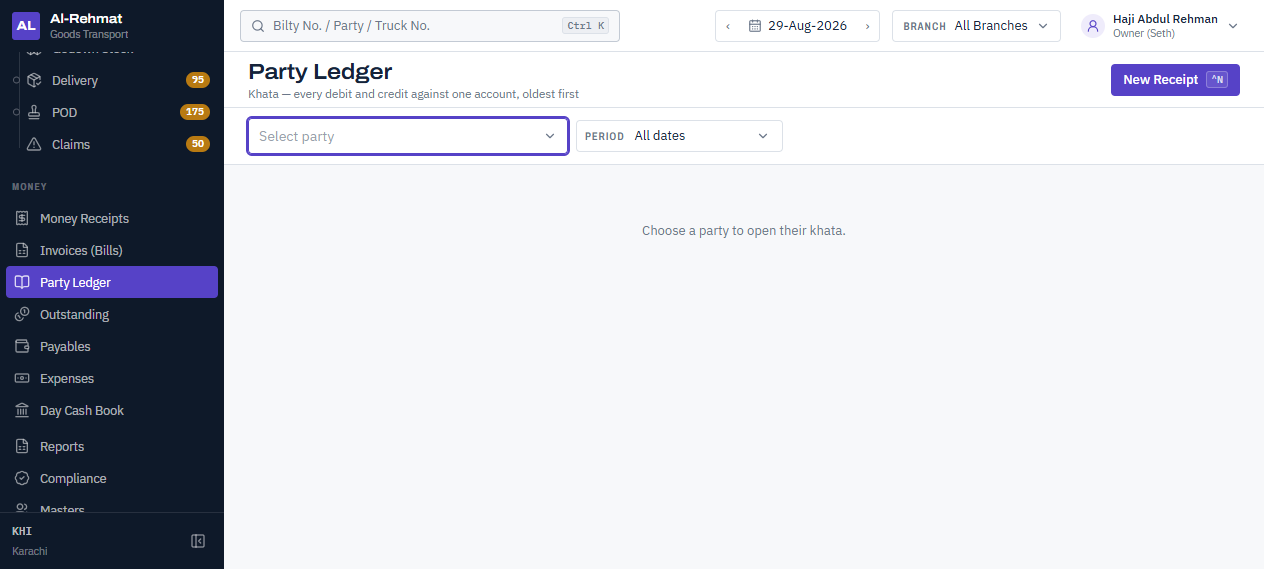
Party ledger screen showing account-wise transaction history for transport clients.
Party ledgers, so the answer to "what does this client owe, and since when" is a lookup rather than an argument.
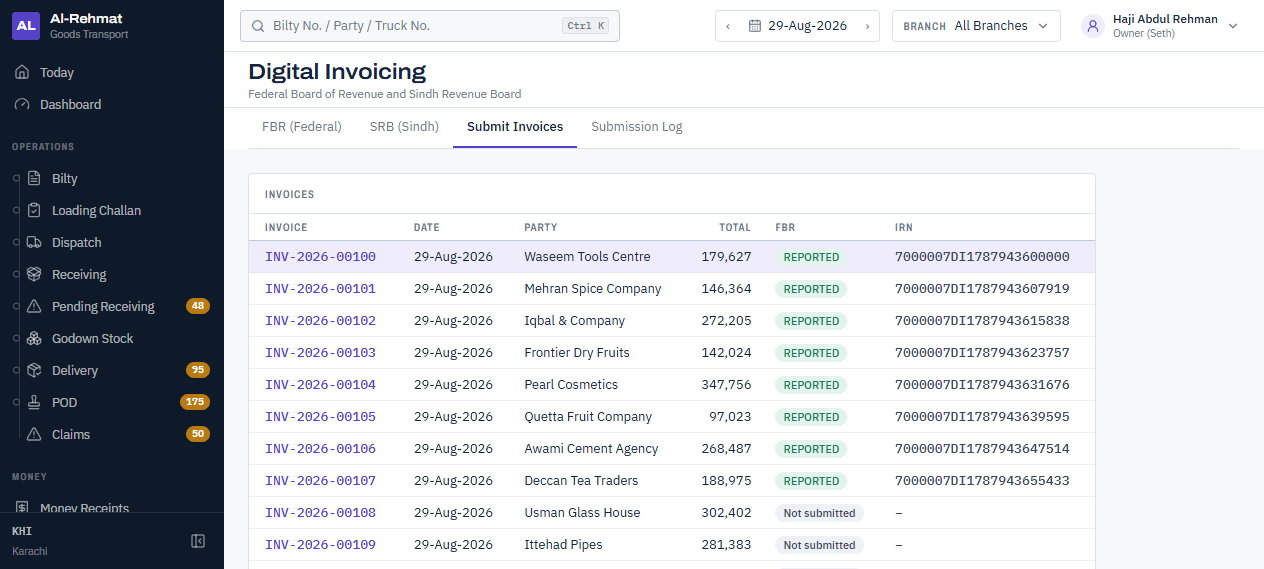
Digital invoicing console listing sales tax invoices with party, total, FBR status and the FBR invoice reference number returned for each reported invoice.
Freight invoices going to FBR from inside the system that raised them, each carrying back its IRN. The same digital invoicing work we already run in production for other clients, wired into a transport company's billing instead of a factory's.

Asked and answered

Can the system tell us what each trip actually earned?

Yes, provided costs are captured against the trip as they happen — fuel, maintenance share, driver advances, tolls and handling. That is the design goal: profitability per trip, vehicle, route and client as a report rather than an annual estimate.

Can drivers update deliveries from the road?

Yes. Systems are mobile-ready as standard, so status updates and proof of delivery can be captured on a phone at the point of handover instead of arriving at the office days later.

Does it track vehicle documents and maintenance?

Yes — fuel, maintenance history and what is due, tyre records, and every vehicle document with its expiry date and a reminder before it lapses.

Can our clients see their consignment status?

Yes, where you want them to. A client-facing view showing only that client's consignments is a standard part of the build, and it removes a large share of the calls the office fields daily.

Do you integrate GPS tracking?

We can integrate an existing GPS provider's data where they expose an API, so vehicle position appears alongside consignment status. We do not sell tracking hardware — we connect what you already run.

Does it handle freight billing and receivables?

Yes: rate structures per client, detention and demurrage as documented lines, bills posting into double-entry accounts, and client balances ageing visibly rather than being reconstructed at the end of the quarter.

Tell us how your operation actually runs.

We scope on-site, specify in writing, and tell you honestly whether custom software is the right answer — before any commitment.